

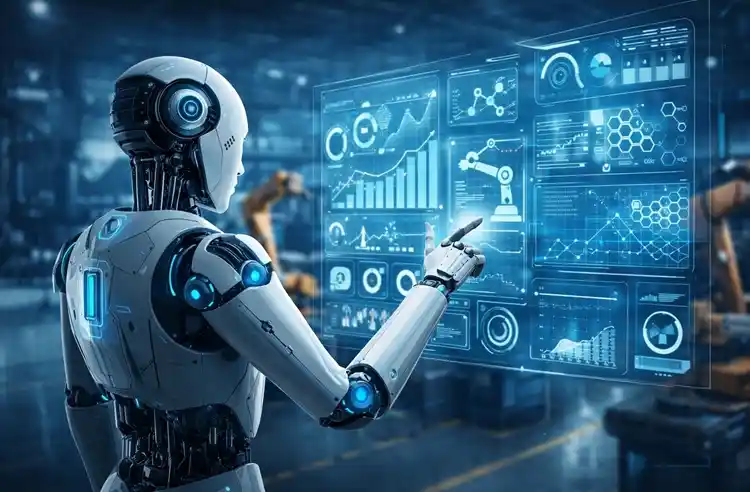
The visible part of physical AI is the robot body. The more important part sits lower in the stack, in the models that connect perception, language, and motion, and in the infrastructure that trains, tests, and updates those models once they leave the lab.
That is why some of the most revealing releases in early 2026 were not new humanoid shells at all. Gemini Robotics 1.5 and Gemini Robotics On-Device made the point in one direction. NVIDIA’s Cosmos, GR00T and Isaac tooling made it in another. The story is moving away from whether a robot can perform a memorable demo and toward whether a full training-and-control loop can hold up under economic pressure.
That distinction matters because the body is getting cheaper faster than the learning problem is getting easier.
| What the eye sees | What the economics care about |
|---|---|
| Humanoid body | Training data and task memory |
| Demo performance | Reliable repetition under constraints |
| Cheapening hardware | Control over simulation and runtime systems |
| Consumer imagination | Factory and logistics deployment |
The body is the decoy
Humanoid hardware still draws the eye first. A pair of arms, a torso, a machine standing where a person used to stand: the image is hard to ignore. But price compression is beginning to separate the body from the moat. Unitree’s G1 is now marketed at a price that would have sounded implausible not long ago, and the company’s lower-end humanoid offering pushes that boundary further. Boston Dynamics says Atlas manufacturing begins immediately, with first deployments scheduled for 2026.
Those are not trivial signals. They show that the body is entering the phase where cost, manufacturability, and repeatability begin to matter more than novelty. But lower body cost does not settle the larger question. If robot bodies keep getting cheaper, which layer of the stack still holds pricing power?
When the body starts to look interchangeable, value moves into the training loop.
That is the part many headline-driven robotics stories miss. A humanoid can become a relatively available chassis long before it becomes a reliable worker. What still has to be built is the memory of work itself: how to move in clutter, how to recover from partial failure, how to interpret ambiguous instructions, how to manage latency, and how to keep improving without drifting into unsafe behavior.
There is an echo here of an older software pattern. Once hardware becomes easier to source, the argument shifts upward into operating logic, data access, and distribution. A related version of that logic runs through Why Data Pipelines Are the New Oil Rigs of AI. Physical AI simply makes the point in a harsher setting. Failure is no longer a bad answer on a screen. It is a dropped component, a stalled work cell, or a machine that hesitates at the wrong moment.
Data is the scarce layer
The hardest part of robotics is still not the motor assembly. It is the data required to produce competent action in the physical world. Language models could train on vast public text. Robots cannot learn manipulation, balance, recovery, and task context from text alone. Physical interaction data is slower, costlier, and much harder to standardize.
That is why simulation and synthetic data are moving from technical side issue to central infrastructure. Cosmos is built around world models and synthetic scenario generation. Waymo’s world model work points in the same direction from autonomous driving. The operating question is no longer just how to train a policy, but how to generate enough plausible edge cases, enough failure states, and enough task variety before hardware ever touches a real workflow.
That changes the sequence of capital allocation. In many settings the order is becoming simulation first, procurement second. The work cell is modelled, the constraints are tested, the edge cases are examined, and only then does the hardware purchase begin to make sense.
Is the real scarcity in physical AI hardware, or in years of task data gathered under failure, recovery, and repetition?
It is also the point where on-device inference becomes more than a technical refinement. A robot that depends too heavily on remote inference inherits latency, bandwidth, reliability, and trust problems that can become expensive very quickly. DeepMind’s on-device push suggests that local autonomy is becoming a basic requirement rather than a premium feature. The deeper implication is simple enough: in physical AI, the model is not just a brain. It is part of a real-time control system.
This is also where open tooling begins to matter. LeRobot’s recent support for Unitree G1 and IsaacLab integration may not look glamorous, but shared tooling shortens the distance between experiment and iteration. It does not remove the hard parts. It does make the stack more legible. That same pressure toward infrastructure rather than spectacle also runs through The $212 Billion Bet: AI’s CapEx Gold Rush.
The factory is not just a customer. It is the place where the model keeps learning under economic pressure.
Why factories move first
Most readers picture the household robot first. It is a natural image because the human form points instinctively toward domestic space. But the payback logic still lives elsewhere. Homes are messy, socially dense, full of exceptions, and hard to standardize. Factories and logistics environments are not simple, but they are bounded. Tasks repeat. Failure can be measured. Process maps already exist.
That is why one of the more important commercial signals this month came from Reuters reporting on Skild AI and NVIDIA deployments at Foxconn assembly lines. It was not just another robot story. It was a stack story: model builder, compute layer, deployment partner, and an operating environment where task repetition creates feedback.
Seen from that angle, the first serious scaling wave in physical AI is less about replacing human presence everywhere and more about finding environments where the trust architecture can be built piece by piece. A bounded factory floor gives the system room to learn. A home asks for competence across clutter, emotion, preference, interruption, and liability all at once.
That does not mean domestic robotics is idle. It means the path to durable adoption looks different from the public imagination. The machine that folds laundry in a normal household still has to be competent in a setting that even humans manage imperfectly. The machine that handles a specific warehouse task only has to be better than the existing cost and error structure.
The tension is not hard to name: the body points toward the home, but the economics still point toward the factory.
For anyone trying to think in longer arcs, that distinction matters more than the demo reel. It sits close to the timing questions raised in AI 2027: Analysis and to the human side of adaptation explored in The Augmented Human. Capability can move faster than deployment. Deployment can move faster than social absorption. And social absorption is often where the real timetable gets rewritten.
Where the moat is likely to settle
The moat does not appear to be settling in one place only, but the pattern is becoming easier to read. The durable layers are beginning to look like some combination of training data, simulation systems, real-time control, safety evaluation, edge deployment, and channel access into places where work already happens.
That is a different claim from saying hardware does not matter. Hardware matters a great deal. But once body design becomes easier to replicate, the harder thing to copy is the loop between data collection, policy updates, deployment support, and operational trust. The companies that own that loop will not need to dominate every robotics headline to shape the economics underneath it.
Many people still treat physical AI as a branch of spectacle, a sequence of clips designed to prove that science fiction has finally arrived. The stronger reading is less cinematic. Robotics is moving toward infrastructure, with all the old pressures that follow: bottlenecks, standards, integration, and control over the hard-to-replace layer.
The body still carries the story. The stack is where control is starting to settle.
That pattern reaches beyond robotics. The broader operating environment of AI is full of cases where value slips away from the visible interface and settles deeper inside the stack. A related frame appears in The Writing on the Wall: Why Everything Changes by 2035. In physical AI, that lower layer is starting to come into view.
FAQ
What is physical AI, exactly?
Physical AI refers to systems that connect perception, language understanding, planning, and motion in machines that act in the real world. In practice, that means the model is tied to control, safety, latency, and task feedback in ways that ordinary software is not. Why Data Pipelines Are the New Oil Rigs of AI
Are humanoid robots really being deployed in 2026?
Yes, but the important point is where and under what conditions. The evidence so far points to factories, logistics settings, and bounded enterprise environments before broad household adoption. Deployment is real, but it is still selective and closely tied to task structure. AI 2027: Analysis
Why do world models and synthetic data matter so much in robotics?
Because robots cannot learn enough from internet text alone. They need exposure to task variety, edge cases, recovery behavior, and physical constraints. World models and simulation systems make it possible to generate and test far more of that before costly real-world deployment begins. The $212 Billion Bet: AI’s CapEx Gold Rush
Why are factories likely to adopt physical AI before homes?
Factories offer tighter process maps, repeated tasks, measurable failure, and cleaner feedback loops. Homes demand broader competence across clutter, interruption, social nuance, and shifting expectations. The result is that industrial deployment has a clearer operating case first. The Writing on the Wall: Why Everything Changes by 2035
Hey I started a sub stack where i will be also publishing some articles. Have a look : CV3 February Briefing
