

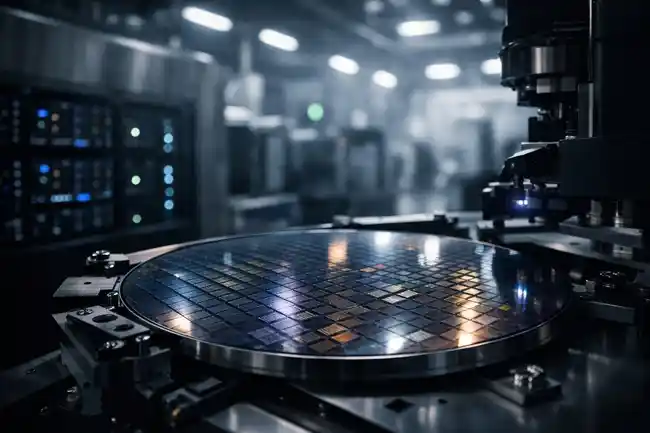
A fab announcement is not a moat. It is more like a course correction — a sign of where a company thinks the shoals will be.
That is the useful way to read Terafab. Not as a magic re-rating switch, and not as proof that Tesla has somehow become every layer of the stack at once. As a bottleneck bet. If the next decade of physical AI is constrained less by steel and more by advanced silicon, then the company that owns more of the scarce layer gains more than supply. It gains bargaining power, timing control, and a cleaner shot at margins.
That still leaves some difficult water ahead. Semiconductor manufacturing is its own hard country. Yields, packaging, tools, power, talent, process learning, and boring reliability all matter. The market does not care that a future system sounds elegant if the present one cannot ship. Terafab may end up mattering a great deal. It may also spend years as an expression of intent before it becomes an operating advantage.
What was actually announced
What is confirmed is narrower than the more enthusiastic write-ups suggest. Elon Musk said Tesla and SpaceX will build advanced chip factories in Austin under the Terafab project. Reuters reported that the plan involves two fabs, each dedicated to a different chip line, and that no firm timeline was given. The same reporting noted that existing suppliers such as Samsung, TSMC, and Micron were framed as insufficient for long-term needs.
That matters because Tesla’s own recent investor materials already show a company leaning harder into physical AI, autonomy, Optimus, AI infrastructure, and in-house silicon rather than trying to remain legible as a plain automaker. Terafab fits that arc. It does not come out of nowhere. It fits the same logic behind AI’s capex gold rush and the broader question of who owns the layers that turn intelligence into deployed systems.
| Claim | What looks defensible now |
|---|---|
| Terafab is real | Yes. The Austin project was publicly announced. |
| It removes supply-chain risk | No. It may reduce one future dependency, but tools, yields, packaging, power, and near-term third-party chip purchases still matter. |
| It replaces Nvidia immediately | No. Musk also said Tesla and SpaceX AI will keep ordering Nvidia chips at scale. |
| It guarantees Tesla a higher valuation | No. That would depend on execution, cost, output, and whether the chips actually change deployment economics. |
The most revealing detail may be the least cinematic one: Tesla and SpaceX AI are still expected to buy Nvidia chips at scale. That is not a contradiction. It is what real transitions look like. Companies do not move from dependency to self-provision in one clean tack. They carry old suppliers and new ambitions at the same time, and the overlap is rarely cheap.
Why this bottleneck matters
The usual auto analysis is a poor fit here. If Tesla’s future rests heavily on robotaxis and humanoids, then the scarce input is not only battery chemistry, stamped metal, or assembly time. It is also edge inference at the right power, cost, and volume. A robot body without enough cheap compute behind it is just an expensive promise. Sometimes the real constraint is less glamorous than the demo suggests. It sits in procurement, supply, and timing.
A fab is not a moat if someone else still owns the harder learning loop.
That is where the thinking gets more interesting. The physical-AI business is not one market. It is several markets forced into each other: foundries, packaging, in-vehicle compute, local robotics models, fleet deployment, simulation, and data collection. Owning one layer can help a lot. It does not erase the others. That is why data pipelines still matter, and why earlier arguments about infrastructure were never really about data centers alone. They were about who gets to own the chokepoints when deployment moves from text to matter.
If you were trying to pressure-test the Terafab thesis properly, the right question would not be whether in-house chips sound impressive. It would be whether cheap, available, purpose-built silicon changes the unit economics of autonomy and humanoids enough to alter rollout speed. A second question follows right behind it: if silicon does become the pinch point, who keeps the rent — the merchant supplier, or the company that pulled the capability inside?
This is also where the article becomes more native to CV3 than to ordinary company coverage. The interesting part is not whether Tesla wants to build a fab. Plenty of ambitious companies want more control. The interesting part is value capture. If a scarce layer can be owned rather than rented, margins, timing, and strategic independence begin to move together.
The real competition by layer
The weak version of the bull case says Terafab has no real competition. The stronger version says the competition is spread across layers, which is harder to dismiss and much more useful to think about.
| Layer | Main rivals | Why they still matter |
|---|---|---|
| Leading-edge foundry | TSMC, Samsung, Intel Foundry | They already have the process, tooling, and learning curve Tesla is trying to compress. |
| Autonomy compute stack | Nvidia | Nvidia is still the reference supplier for much of the market, from in-vehicle compute to cloud training and simulation. |
| Robotaxi deployment | CyberCab + Waymo and other AV operators building live service footprints | A chip is only as valuable as the system it helps deploy at scale. |
| Humanoid deployment | Optimus, Figure, Unitree, and other robotics builders | Optimus is not competing against theory. It is competing against machines already learning in factories and warehouses. |
| Local robotics models | Google DeepMind and other robotics-model teams | Owning silicon helps, but low-latency local models and control loops are a separate race. |
Start with foundries. TSMC says its N2 process entered volume production in the fourth quarter of 2025. Samsung has been pushing combinations of advanced process and packaging. Intel Foundry continues to pitch 18A as a major process step built around RibbonFET and backside power delivery. Tesla is not entering an empty field. It is entering a field occupied by firms whose entire institutional memory is process yield and manufacturing discipline.
Then there is Nvidia. The easy mistake is to treat Nvidia as yesterday’s dependency because Tesla wants more of the stack in-house. That understates how broad Nvidia’s position is. Its DRIVE stack spans in-vehicle compute, safety systems, training, simulation, and an ecosystem of automakers and autonomy developers. It is not just selling chips. It is selling a path. That suggests the bridge period may be longer than cleaner narratives imply.
On the deployment side, Tesla is also not alone. Waymo is already running commercial fully autonomous ride-hailing and expanding its service footprint. That does not make Waymo the same kind of company as Tesla, but it does make it a live competitor in the one place that matters most: the real world, where fleets, safety cases, operations, and rider habits turn theory into revenue, delay, or a slower rollout than the headlines first implied.
The same goes for humanoids. Figure says its robots contributed to the production of more than 30,000 BMW X3 vehicles before the retirement of Figure 02, and it has since introduced Figure 03 and newer autonomy work. That does not settle the race. It does, however, make one thing plain: Optimus is not competing against a slide deck. It is competing against machines already earning their way into operating environments. That is one reason the earlier CV3 framing on physical AI remains useful here.
Then there is the quieter contest around local robotics models. Google DeepMind’s Gemini Robotics On-Device is built for local deployment and fine-tuning on robots with tighter compute budgets. That matters because a lot of value in physical AI may sit not in the biggest model, but in the model that can run where latency, power draw, and cost actually allow deployment. If Terafab works, it helps Tesla here. It does not remove the need to win here.
The competition is layered, not singular. A stronger hull does not change the weather.
That is why this story fits long-horizon scenario thinking better than ordinary company coverage. A company can own more fabs, more code, and more robotics ambition, and still fail if the layers do not line up at the same moment. Sometimes the missing part is not intelligence. It is timing, and whether the rest of the vessel is ready when the wind finally turns.
This piece is not an investment call. It is a structural reading of an early announcement, and several of the louder claims around Terafab still sit well ahead of what has been publicly confirmed.
FAQ
What is Tesla’s Terafab, in plain language?
In plain language, it is an announced plan to build advanced chip factories in Austin for Tesla and SpaceX-related AI needs. The useful interpretation is that Tesla is trying to pull a scarce part of the future physical-AI stack closer to home rather than renting that scarcity forever.
Does Terafab mean Tesla no longer needs Nvidia?
No. The public reporting points the other way. Tesla and SpaceX AI are still expected to keep buying Nvidia chips at scale, which means Terafab is better read as a medium-range hedge on supply and cost than as an overnight break from outside compute dependence.
Who is the real competition to Terafab?
At the foundry layer it is TSMC, Samsung, and Intel Foundry. At the autonomy-compute layer it is Nvidia. At the deployment layer it is firms like Waymo in robotaxis and players such as Figure or Unitree in humanoids. The mistake is to search for one rival when the contest is spread across several hard layers at once.
Why does chip supply matter so much for robotaxis and humanoids?
Because the body is not the whole product. Autonomy and embodied AI need local compute, safety overhead, model updates, and cost control at volume. If advanced silicon stays scarce or expensive, rollout speed can slow even when the rest of the machine is ready.
