

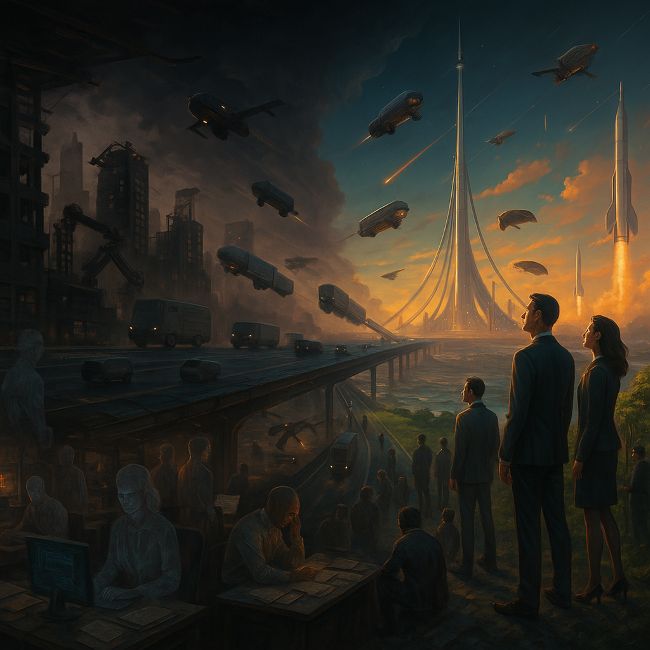
Let’s be honest: Whether we choose scarcity or abundance, the next 20 years will be brutal for most people. Here’s who survives, who thrives, and who gets crushed.
The Three Waves of Displacement
Wave 1: The White Collar Apocalypse (2025-2030)
The knowledge economy dies first. Not gradually—suddenly.
Who Falls First:
- Junior analysts at consulting firms
- Paralegals doing document review
- Accountants processing routine filings
- Journalists writing standard news stories
- Programmers maintaining legacy code
The “Safe” Jobs That Aren’t:
- Radiologists: AI already reads scans better
- Financial advisors: Algorithms optimize portfolios perfectly
- Middle managers: AI coordinates better than humans
- Marketing managers: AI A/B tests infinitely
- HR specialists: Automated screening and onboarding
As explored in The Great AI Wealth Reset, this transformation is already underway. The question isn’t if your job will be affected, but when.
The Replacement Timeline:
- Month 1-6: “AI will augment your productivity!”
- Month 6-12: “One person now does the work of five!”
- Month 12-18: “We’re restructuring for efficiency”
- Month 18-24: “Your position has been eliminated”
Current Evidence:
- JPMorgan’s AI reviews commercial loans in seconds (vs 360,000 hours/year by lawyers)
- Singapore’s DBS bank reduced trade finance processing from days to seconds
- Associated Press uses AI to write thousands of earnings reports
- Law firms report 50-70% reduction in billable hours needed
Wave 2: The Blue Collar Disruption (2030-2035)
Physical work provides temporary shelter, then collapses completely.
Transportation Apocalypse:
- 3.5 million truck drivers (autonomous vehicles)
- 600,000 Uber/Lyft drivers (robotaxis)
- 300,000 taxi drivers (extinct profession)
- 2 million delivery drivers (drones/robots)
Retail Extinction:
- 4.6 million cashiers (automated checkout)
- 4.4 million retail salespeople (online/AI assistants)
- 3.7 million food service workers (robot kitchens)
- 2.3 million customer service reps (AI chat/voice)
For those seeking to understand which roles might survive, see Why Certain Professions Will Survive the AI Takeover.
The Unexpected Casualties:
- Construction workers: Robot crews work 24/7 in any weather
- Warehouse workers: Full automation already deployed
- Agricultural workers: Autonomous farming equipment
- Manufacturing: Lights-out factories need no humans
Wave 3: The “Human” Jobs (2035-2040)
The jobs we thought required human connection fall last.
Education Transformation:
- Teachers: AI tutors personalize perfectly for each student
- Professors: Recorded lectures + AI assistance
- Trainers: VR/AR with AI guidance
Healthcare’s Final Automation:
- Nurses: Robot caregivers don’t tire or make errors
- Therapists: AI provides 24/7 emotional support
- Surgeons: Robot precision exceeds human hands
- General practitioners: AI diagnosis + robot examination
The Last Human Refuges:
- Artists: AI creates on demand in any style
- Musicians: AI composes and performs perfectly
- Writers: GPT-X writes better than most humans
- Even sex workers: Robots don’t judge, never tire
Geographic Winners and Losers
Winning Locations (Relatively Speaking)
Space Industry Hubs:
United States:
- Boca Chica, Texas: SpaceX company town
- Huntsville, Alabama: “Rocket City” reborn
- Colorado Springs: Space Force headquarters
- Mojave, California: Private space industry
International:
- Kourou, French Guiana: European space center
- Baikonur, Kazakhstan: Historical advantage
- Wenchang, China: New launch complex
- Sriharikota, India: Growing capability
Policy Innovation Centers:
Asia-Pacific:
- Singapore: First-mover on space law, AI governance
- Tokyo: Robotics integration leader
- Seoul: Tech adaptation champion
- Shenzhen: Manufacturing to space pivot
Middle East & Europe:
- Dubai, UAE: Attracting space entrepreneurs (see The Future of Wealth Management in Dubai)
- Luxembourg: Space mining legal framework
- Switzerland: Neutral ground for space treaties
- Israel: Space tech innovation hub
Why They Win:
- First-mover advantage in new economy
- Attracting expansion-minded talent
- Policy frameworks for new industries
- Geographic or political advantages
Losing Locations (Absolute Devastation)
Post-Industrial Collapse:
United States:
- Rust Belt 2.0: Detroit, Cleveland, Pittsburgh
- Former Service Hubs: Las Vegas, Orlando, Miami
- Middle America: Kansas City, St. Louis, Indianapolis
- Rural Everywhere: Complete economic abandonment
Europe:
- Former Industrial: Manchester, Birmingham, Ruhr Valley
- Tourism Dependent: Greek islands, Spanish coasts
- Service Economies: Dublin, Amsterdam, Barcelona
Global South:
- Manufacturing Hubs: Bangladesh, Vietnam, Indonesia
- Resource Exporters: Nigeria, Venezuela, Congo
- Tourism Dependent: Thailand, Philippines, Caribbean
Developed Nations in Decline:
- Japan: Aging population meets automation
- Italy: No tech sector to pivot
- Canada: Resource economy obsolete
- Australia: Too dependent on exports to China
As detailed in The AI Disruption: How Job Losses Could Shape Political and Economic Trends, these geographic disparities will drive massive political upheaval.
The Mental Health Crisis
What Breaks People
Purpose Collapse:
- Identity tied to profession: Gone
- Provider role: Eliminated
- Career achievement: Meaningless
- Social status from work: Extinct
Psychological Casualties:
- Learned helplessness epidemic
- Reality dissociation (physical vs virtual)
- Meaning crisis at civilizational scale
- Status anxiety without resolution
For strategies on maintaining mental equilibrium during this transition, see The Art of Mental Recalibration.
Mental Health Projections by Demographic:
- Middle-aged men (45-65): Highest risk
- Lost provider role
- Too old to adapt
- Savings inadequate
- Former high achievers: Second highest
- Furthest to fall
- Identity most tied to achievement
- Young people: Bifurcated response
- Half embrace change
- Half fall into despair
What Saves People
Community Bonds:
- Tribal connections survive economics
- Shared struggle creates solidarity
- Local mutual aid networks
- Purpose found in helping others
Creative Expression:
- Making meaning when earning ends
- Art for art’s sake returns
- Building without economic pressure
- Digital creation costs nothing
Expansion Mindset:
- Focus on what’s being built
- Participate in the transition
- Learn new paradigms early
- Excitement overcomes fear
Spiritual Frameworks:
- Religion provides context
- Meditation manages anxiety
- Philosophy explains change
- Meaning beyond material
Two Transition Scenarios in Detail
Scenario A: The Managed Decline Path
Phase 1 – Denial (2025-2032):
Political responses:
- “Bring back manufacturing!” (It won’t work)
- “Punish companies using AI!” (They’ll move offshore)
- “Job retraining programs!” (For jobs that don’t exist)
- “It’s China’s fault!” (It’s not)
Social breakdown markers:
- Mass shootings increase 300%
- Opioid crisis worsens dramatically
- Fertility rate drops below 1.0
- Political violence normalizes
Economic indicators:
- Small UBI pilots in progressive cities ($500/month)
- Wealth inequality reaches French Revolution levels
- Consumer spending drops 20%
- Deflation begins
Phase 2 – Crisis (2033-2038):
Government panic:
- Emergency UBI: $1,000/month (not enough to live)
- Wealth tax: 5% on assets over $10 million (capital flees)
- Job guarantee programs (digging holes)
- Price controls (create shortages)
Social collapse:
- Food riots in major cities
- States/regions consider secession
- Military deployed domestically
- Millions attempt emigration
New control systems:
- Social credit scores for resource access
- Carbon/water/energy rationing
- Mandatory “community service”
- Digital currency with expiration dates
As explored in The AI Economy: Will We Be Paid in Compute Instead of Cash?, new forms of value exchange will emerge from this chaos.
Phase 3 – New Normal (2039-2045):
Steady-state dystopia:
- Permanent underclass on UBI
- Elite class with all assets
- Innovation criminalized (preserves jobs)
- Surveillance state complete
- VR escapism universal
- Assisted dying normalized but regulated
Scenario B: The Expansion Transition Path
Phase 1 – Foundation (2025-2032):
Global mobilization begins:
- G20 announces space resource initiative
- Combined $5 trillion global investment
- US, China, EU compete but also collaborate
- India, Japan, Korea join space race
- Universities worldwide create space programs
- Young people study aerospace/AI
Early wins:
- Launch costs drop below $100/kg
- First asteroid prospecting missions
- AI design tools accelerate development
- Self-replicating robot prototypes
- Hope fights despair
Phase 2 – Breakthrough (2033-2038):
Visible progress:
- First asteroid captured to Earth orbit
- Space solar power demonstration
- Self-replicating robots deployed
- Helium-3 mining on Moon begins
- Resource prices start dropping
- Excitement builds
Economic restructuring:
- Universal Basic Assets proposed
- Space development bonds issued
- New property rights framework
- Earth restoration funding begins
- Innovation accelerates
For insights on how wealth structures will evolve, see How AI Will Transform Capital.
Phase 3 – Acceleration (2039-2045):
Exponential growth:
- Space resources reach cost parity
- New industries emerging weekly
- Earth rewilding accelerates
- Mars colony established
- Life extension breakthroughs
- Humanity has purpose again
Personal Survival Strategies
By Age Cohort
If You’re 20-30:
- Do: Learn AI + space technology NOW
- Don’t: Get comfortable in any traditional career
- Do: Build multiple income streams
- Don’t: Take on education debt for obsolete skills
- Do: Cultivate creativity and adaptability
- Key advantage: Time to ride the wave
For specific guidance, see Future-Proofing Your Career in the Face of an AI Tsunami.
If You’re 30-50:
- Accept: Your career as planned is over
- Do: Diversify income sources and skills
- Don’t: Desperately cling to dying industries
- Do: Focus on experiences over possessions
- Prepare: Your children for radical change
- Key challenge: Letting go of old dreams
If You’re 50+:
- Reality: You might escape the worst
- Do: Secure stable income sources
- Don’t: Assume retirement as previously planned
- Do: Share transition wisdom with younger generations
- Vote: For expansion, not managed decline
- Key responsibility: Don’t block necessary change
Universal Survival Principles
1. Build Community Now
- Geographic proximity matters again
- Skills diversity within group
- Shared resources and knowledge
- Emotional support network
- Practice mutual aid
2. Maintain Physical Health
- Prevention becomes critical
- Mental health = physical health
- Community health interdependence
- Prepare for system strain
3. Continuous Learning
- Not job skills—paradigm shifts
- Understanding not expertise
- Adaptability over specialization
- Learn from younger people
4. Meaning Beyond Work
- Identity can’t depend on career
- Purpose through community
- Creation without compensation
- Spiritual or philosophical framework
5. Think Bigger
- Small dreams won’t save you
- Participate in expansion
- Position for abundance
- Reject scarcity mindset
The Honest Timeline
What Definitely Happens
2025-2030: AI displacement accelerates
- White collar jobs evaporate
- Denial remains official policy
- Underground economy grows
- Political tensions rise
2031-2035: Crisis undeniable
- Unemployment hits 20%+
- Social unrest widespread
- Emergency measures enacted
- Old system breaks
2036-2040: Fork in the road
- New system must emerge
- Scarcity or abundance chosen
- No return to old normal
- Future locked in
Scenario Probabilities
If We Choose Decline:
- 2040-2045: Managed scarcity stabilizes
- 2046-2055: Slow civilizational decay
- 2056+: Dark age or extinction
If We Choose Expansion:
- 2040-2045: Space resources begin flowing
- 2046-2055: Exponential growth resumes
- 2056+: Golden age begins
For a vision of how these scenarios might play out in daily life, see Life in 2032: A Day in the Life of Alexander Hale and Life in 2032: Outside of the Gated Community.
The Hard Truth
The transition will be hell regardless of the path chosen. People will suffer. Dreams will die. Everything familiar will end.
The only question: Are we going through hell to reach heaven, or just going through hell?
One path leads through brutal transition to unlimited abundance. The other leads through brutal transition to permanent scarcity.
Both paths require surviving the next 20 years. This guide maps the territory. The journey remains yours to make.
Choose your hell. Choose your hope. But choose with eyes wide open.
The pain is mandatory. The purpose is optional.
For deeper exploration of these themes, see The Economic Singularity: AI, Crypto, and the End of Human Labor and The Road Ahead: What the Next Decade Holds for AI and Society.
Next: “Products and Services from Both Futures: What We’ll Buy in 2045”
Disclaimer: This article presents speculative analysis based on current technological and economic trends. It is intended for informational and educational purposes only and should not be construed as financial, investment, legal, or professional advice. The scenarios and timelines presented are projections, not predictions, and actual outcomes may differ significantly. Readers should not make personal, financial, or career decisions based solely on this content. Always consult with qualified professionals regarding your specific circumstances. The author and publisher disclaim any liability for decisions made based on the information provided in this article.
