

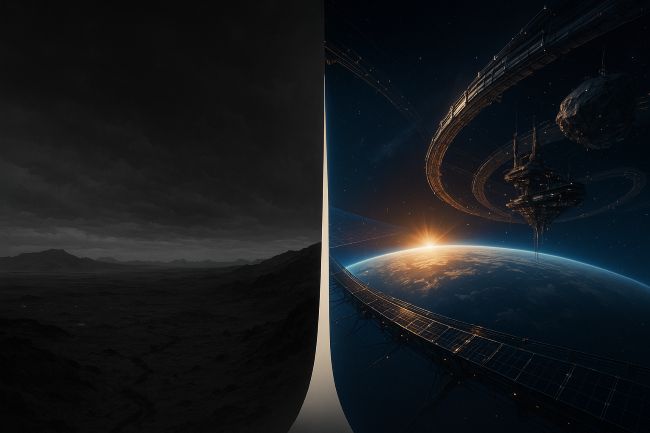
We stand at the fork. Down one path lies carefully managed resource allocation. Down the other, explosive growth into the cosmos. This choice will echo for a thousand years. Let’s examine both paths.
The Physics of Inevitability
Why Scarcity Is Actually Harder
The mathematics of managed decline reveal a startling truth: maintaining scarcity requires more energy than creating abundance.
Energy Reality:
- Earth sustainable capacity: 20 TW maximum
- Current global usage: 18 TW
- Projected needs by 2045: 50 TW (with current tech)
- Available in space: 384,000,000,000,000,000 TW (full solar output)
The scarcity path requires perfect global coordination to manage 20 TW. The abundance path requires only reaching for what’s already there.
The Coordination Problem:
- Scarcity requires 195 nations to agree on rationing
- One defector breaks the entire system
- History shows: Global cooperation on constraints fails
- Example: 30 years of climate agreements, emissions still rising
The Human Nature Problem:
- Growth is encoded in our DNA
- Constraining growth requires extensive oversight
- Oversight requires energy (monitoring, enforcement, administration)
- Using energy to prevent energy use is thermodynamic insanity
History shows this pattern repeatedly – civilizations either expand or contract, as detailed in this analysis of The Great Economic Reset. The same dynamics that drove past empires to rise or fall now operate at planetary scale.
Why Abundance Is Actually Easier
The Incentive Alignment:
- First movers gain access to vast space resources
- Competition naturally drives progress
- Benefits compound exponentially
- Cooperation emerges from abundance, not scarcity
The Technical Reality:
- Launch costs: Dropping 10x per decade
- AI capability: Doubling every 6 months
- Self-replication: Changes linear to exponential
- Physics: No laws prevent it, economics demands it
The speed of change continues to accelerate. Just as Facebook’s emotion experiment showed how quickly digital systems can influence behavior, AI’s influence on employment will shift from subtle to overwhelming between 2025 and 2030.
Historical Pattern:
- Sailing ships: “Impossible” to “Inevitable” in 200 years
- Railways: “Impossible” to “Everywhere” in 70 years
- Internet: “Impossible” to “Essential” in 30 years
- Space resources: “Impossible” to “______” in 20 years?
The Timeline Crystallized
The Next 30 Years – Two Paths Diverge
2025-2030: The Foundation Phase
Scarcity Path Actions:
- Deny the AI displacement reality
- Blame external factors for job losses
- Implement short-term relief measures
- Hope traditional employment returns
- Waste critical preparation years
Abundance Path Actions:
- Acknowledge the transformation openly
- Begin space infrastructure investment
- Create AI-space development partnerships
- Inspire young people with frontier vision
- Build momentum while we still can
Understanding what’s wrong with AI today helps us see why the next decade changes everything. The limitations disappearing now are the same ones that protected human employment.
2030-2035: The Crisis Phase
Both paths face the same crisis:
- 25% unemployment undeniable
- Social unrest widespread
- Old systems breaking down
- Population demanding solutions
- Choice becomes unavoidable
Scarcity Response:
- Emergency UBI at subsistence level
- New tax structures trigger capital movement
- Public works programs for appearance
- Resource allocation systems begin
- Family planning incentives introduced
Abundance Response:
- Emergency UBI as bridge funding
- Economic incentives aligned with space development
- Retraining for space/AI industries
- First asteroid capture mission
- Population inspired by progress
By 2032, the contrast will be stark. Compare Alexander Hale’s life in the gated community with Martha’s experience outside. These aren’t just different lifestyles – they’re different worlds.
2035-2040: The Divergence
Scarcity Trajectory:
- Permanent welfare state established
- Innovation heavily regulated to preserve employment
- Comprehensive monitoring for resource allocation
- Family size incentives implemented
- Managed decline accepted as normal
Abundance Trajectory:
- Space resources begin flowing
- New industries emerging monthly
- Earth restoration projects begin
- Mars colony under construction
- Golden age anticipation builds
2040-2050: The Destination
Scarcity Endpoint:
- Population: 7 billion and falling
- Energy per capita: 2.8 TW (decreased 40%)
- Wild Earth: 10% (wilderness areas, rest needed for resources)
- Innovation rate: Carefully managed
- Human purpose: Minimize footprint
- Cultural mood: Resigned acceptance
Abundance Endpoint:
- Population: 9 billion Earth, 100 million space
- Energy per capita: 20,000 TW (increased 1,000x)
- Wild Earth: 50% (rewilding – returning land to natural state)
- Innovation rate: Exponential
- Human purpose: Maximize potential
- Cultural mood: Explosive creativity
What Each Path Really Means
Scarcity Path – The Honest Assessment
What It Requires:
- Accept Earth’s limits as absolute
- Trust global governance systems
- Moderate human ambition collectively
- Manage expectations carefully
- Maintain social harmony through policy
What It Delivers:
- Survival for most populations
- Stability through strict resource management
- Sustainability through reduced consumption
- Equality of resource access
- Peace through shared sacrifice
What It Costs:
- Human potential constrained
- Individual choices limited
- Innovation carefully controlled
- Growth becomes regulated
- Hope replaced with acceptance
The Hidden Truth: Even perfect scarcity management only delays difficult choices. Entropy increases in closed systems.
Abundance Path – The Honest Assessment
What It Requires:
- Believe expansion is achievable
- Embrace societal-level innovation and exploration
- Support emerging space and AI technologies through policy
- Think in centuries not election cycles
- Accept transitional challenges
What It Delivers:
- Prosperity beyond current imagination
- Freedom through infinite resources
- Sustainability through expansion
- Initial inequality, eventual abundance
- Peace through plenty
What It Costs:
- Major public investment required
- Transition period challenges
- Some benefit later than others
- Unknown risks accepted
- Comfortable assumptions questioned
The Hidden Truth: Abundance doesn’t solve human nature, but it makes our problems better problems to have.
Why Existing Powers Will Choose Abundance
The Economic Calculation
The wealthy aren’t waiting passively. They’re applying the same strategies used throughout history – from the Medici family’s wealth preservation during exile to modern billionaires’ multi-generational wealth strategies. But this time, they’re thinking beyond Earth.
In the Scarcity Scenario:
- Wealthy control larger percentage of shrinking resources
- Total resource base contracts each generation
- Historical tensions between classes intensify
- Past examples: Social upheavals during resource crunches
- Future generations inherit diminished world
In the Abundance Scenario:
- Wealthy control smaller percentage of expanding resources
- Total resource base grows exponentially
- Class tensions ease as all boats rise
- Past examples: Industrial Revolution’s broad benefits
- Future generations inherit expanded possibilities
This isn’t just theory. Look at how tech has already shaped the super-billionaires list. The next wave won’t just create individual fortunes – it’ll create or destroy entire civilizations’ wealth.
The Geopolitical Reality
Nations, like individuals, respond to incentives. As explored in Will Nation-State AI Determine the Next 1,000 Year Superpower?, the country that masters AI and space first gains decisive advantage.
If USA Chooses Scarcity:
- Other nations choose abundance and dominate
- American century ends in managed decline
- Democratic values face existential test
- Free world influence diminishes
If USA Chooses Abundance:
- Competition drives all nations forward
- American innovation combines with global manufacturing
- Democracy proves superior for fostering creativity
- Free world leads expansion
The NASA-SpaceX Preview:
- NASA (traditional approach): High cost per launch
- SpaceX (abundance mindset): 100x cost reduction
- Result: New space economy emerging
This pattern will replay at civilizational scale.
Answering Every Objection
“But space is too hard!”
Response: So was every expansion in history.
- Flight (1900): “If God wanted us to fly…”
- Moon landing (1969): Achieved with slide rules
- Reusable rockets (2015): “Impossible” until done
- Neural interfaces (2024): Science fiction until reality
The Pattern: “Impossible” is just “inevitable” with insufficient imagination.
“But it will take too long!”
Evidence of Speed When Motivated:
- Manhattan Project: Theory to application in 3 years
- Apollo Program: Announcement to achievement in 8 years
- COVID vaccine: Development to distribution in 1 year
- Starlink: Concept to global coverage in 5 years
- ChatGPT: Research to world-changing in 2 years
Reality: We move at the speed of necessity. The Accelerating AI Revolution shows how each breakthrough enables the next faster.
“But what about Earth?”
Scarcity Path: Earth still degrades through poverty-driven exploitation Abundance Path: Earth heals when industry moves to space
Moving heavy industry off-planet is the ONLY way to restore Earth’s biosphere. Rationing just manages decline.
“But inequality!”
Scarcity: Everyone equally constrained Abundance: Unequal but everyone better off
Which actually helps more people – equal limitations or unequal prosperity?
As explored in AI and Wealth Inequality, the gap matters less when the floor keeps rising. It’s better to be unequally wealthy than equally poor.
“But the transition will be brutal!”
Yes. Both paths involve difficult transitions.
The question: Difficult transition to what?
- To permanent scarcity and managed decline?
- To unlimited abundance and human flourishing?
Pain with purpose is bearable. Pain without purpose breaks spirits.
The Call to Action
For Individuals
Individual preparation matters. While we can’t all become space entrepreneurs, we can develop what matters: mastering our inner dialogue to handle uncertainty, and recalibrating mentally for a radically different future.
If you’re young (under 30):
- Study AI + space technology NOW
- Think bigger than previous generations
- Reject scarcity programming
- Build for the abundant future
- Your generation inherits the choice
For career guidance, see Future-Proofing Your Career in the Face of an AI Tsunami and AI Strategies for Executive Career Longevity.
If you’re middle-aged (30-60):
- Support expansion-oriented policies
- Teach children possibility not limits
- Vote for builders not managers
- Invest time in understanding the shift
- Your generation implements the choice
If you’re older (60+):
- Share stories of past expansions
- Support youth reaching for stars
- Vote against managed decline
- Leave legacy of growth not fear
- Your generation validates the choice
For Organizations
Companies:
- Pivot to abundance technologies
- Plan for exponential not linear growth
- Automate everything possible
- Prepare for space economy
- Compete on creation not efficiency
Understanding how AI scaling lets small teams compete reveals why traditional business models face extinction.
Governments:
- Fund space infrastructure like interstate highways
- Reform laws for space property rights
- Compete constructively with other nations
- Inspire citizens with frontier vision
- Lead expansion or become irrelevant
The New AI Landscape: Europe’s Strategic Response shows how different regions are positioning themselves for this transition.
Universities:
- Teach expansion mindset alongside sustainability
- Research abundance technologies
- Prepare students for growth careers
- Update economic models for abundance
- Create the intellectual framework
For Humanity
The Choice Is Not:
- Between easy and hard (both paths are hard)
- Between safe and risky (both paths risk everything)
- Between moral and immoral (both paths have costs)
The Choice Is:
- Between closed and open futures
- Between limits and limitless
- Between managed decline and managed growth
- Between Earth-only and multi-planetary
- Between scarcity and abundance
The Vision That Pulls Us Forward
Imagine 2075 – Abundance Realized
Your grandchildren live in a world where:
- Energy is unlimited and clean
- Resources are infinite
- Creativity is the only constraint
- Death is optional not mandatory
- Suffering is chosen not imposed
- Humanity spreads across stars
- Each person wields power of today’s nations
- Art exists at galactic scale
- Purpose comes from building wonders
This mirrors the pinnacle of prosperity described here, where knowledge and creativity become the true wealth.
Imagine 2075 – Scarcity Accepted
Your grandchildren live in a world where:
- Energy is carefully rationed
- Resources strictly controlled
- Creative expression primarily digital
- Lifespans managed for sustainability
- Suffering is minimized through management
- Humanity slowly consolidates
- Each person monitored for efficiency
- Art follows approved patterns
- Purpose found in community harmony
The Historical Moment
We are the pivot generation. The inflection point. The fork in the road.
Previous generations faced local choices. We face a species choice.
Previous expansions opened continents. We open the universe.
Previous limits were regional. Our limit is planetary.
The choice we make echoes through time:
- Choose scarcity: Humanity’s story becomes about management
- Choose abundance: Humanity’s story just beginning
The Physics Demands Decision
Closed systems tend toward entropy. Open systems grow through energy flow.
Earth is becoming a closed system. Space makes it open again.
This isn’t philosophy. It’s thermodynamics.
The Final Question
Not “Can we afford to expand?” But “Can we afford not to?”
Not “What if we fail?” But “What if we succeed?”
Not “Is it realistic?” But “Is the alternative acceptable?”
As examined in The Metamorphosis: Humanity in the Age of Thinking Machines, we’re not just choosing an economic system – we’re choosing what humanity becomes.
The Fork in the Road
One path leads to carefully managed resources, considered consumption, and gradual consolidation of human activity.
The other leads to explosive growth, unlimited resources, and the birth of a galactic civilization.
We are the generation that chooses.
Choose abundance. Choose expansion. Choose the stars.
The alternative isn’t just limiting—it’s accepting limits as permanent.
The opportunity isn’t just available—it’s necessary for long-term survival.
The time isn’t tomorrow—it’s now.
The future is being written. Will we write a story of limitation or liberation?
Join us at the fork. Choose the path that leads somewhere worth going.
The stars aren’t just our destination—they’re our birthright.
Claim it.
Note: This analysis presents potential futures based on observable trends, not investment guidance or political advocacy. When we discuss societal choices, we mean democratic decision-making through existing institutions. All speculation about government policies refers to potential legislative changes through normal democratic processes. No illegal activities are suggested or endorsed.
Disclaimer: This manifesto presents a framework for thinking about humanity’s future based on current technological and economic trends. It is intended to provoke thought and inspire discussion about long-term civilizational choices. The scenarios, timelines, and projections are speculative extrapolations, not certainties. This content should not be construed as financial, investment, or professional advice. The author advocates for thoughtful consideration of our collective future but acknowledges that reasonable people may reach different conclusions. Readers should think critically, consult diverse sources, and participate in democratic processes to help shape humanity’s path forward. The future remains unwritten, and many voices should contribute to its authorship.
